Showing posts with label Teri Clark Linden. Show all posts

Monday, September 24, 2018

I'M IN NYC

2013, October
On Katharine Hepburn's Block

Sitting in "Nations Cafe" on 49th and 1st. I asked if this has always been a restaurant and was told since 1962, thought it used to be smaller. (A customer, a woman who lives across 1st remembered it opening then.)

On the same side towards 2nd is Katharine Hepburn's Turtle Bay brownstone she purchased in 1937 for $27,500.00. I know this because I'm re-reading her autobiography ME given to me by my grandmother for my 25th birthday, inscribed "To Teri with Love, Nana, October 4, 1991." I have always been attracted to who Katharine Hepburn was. A good actress, yes, but more than being a fan of her work I think I'm a fan of how she lived and how that translated into the roles she played. I've read so many biographies about her and one constant is her strong sense of who she was and where she came from without question. Without question.

Tour buses keep passing by and I wonder if the Hepburn residence is a POI.

Katharine Hepburn didn't go to therapy. I think she got it out on stage and in front of the camera. I do that. Cathartic moments through the work. (Was Katharine Hepburn here at Nations Cafe?) Her driver, Charles Newhill - "Mayor" of her block - was he? Am I walking in her steps?

My grandfather, Elmer Clark, lived and worked in Manhattan on Wall Street in the '20's. Pre-dated Katharine Hepburn a bit. They may have crossed paths. When she first arrived and was going on castings. She drove then. Wrote in ME that one could in NYC back then. It was a different time. Oh, and the $27K she bought 244 East 49th with? There's a 2010 Internet listing to lease the place for $27K a month. Just about the same price Katharine Hepburn bought the apartment for in 1937 will by 1 month, 4 weeks rent, today. (That would be about what one 13-week contract recording about 18 audio books - 180 hours of recorded material - would buy me - 1 month in Katharine Hepburn's Turtle Bay apartment.)

I'm seeing LION KING again in 1 hour and 10 minutes. Taking Molly who lets me stay with her in Queens when I visit. (I think I may be outgrowing these visits...really? Why do I think that?) LION KING is a very God-experience for me. I don't see much theatre anymore since moving to Ohio. I'd rather spend my money seeing the LION KING again and again than on something I most likely find mediocre.

LATER
On way into city - will go to Benetton and see agent.

What do I know or believe after 4 days in NYC? What is true or truer for me?
  • It's not becoming to discuss money. 
  • It's not becoming to criticize or become negative. 
  • I would definitely speed up my aging process if I lived here. 
  • I miss acting on the stage. 
  • I miss acting Shakespeare. Seeing Shakespeare. I'm good at it. 
  • It's good to miss Sam and for Sam to miss me. Sam gets along with his Dad just fine without me.
  • It's important to go away for me. I feel more like me. 
  • I'm thankful for my home. I have so many thanks. I'm blessed. 
  • I need to work. I need to perform. 
  • I don't believe actors in bad productions aren't trying their best (I blame the director.) Romeo and Juliet on Broadway is the director's fault. 
  • I can have hopes, wishes and dreams, but I can't chase them. (Let go, let God.) 
  • One way God reaches people is through me when I'm performing (especially on stage.) 
  • I am very, very open, very compassionate. Very aware. 
  • Despite daily pounding on my emotions, my true self prevails. 
  • I am stronger than my enemies. 
  • I'm not getting older, I'm outgrowing. Growing out. 
  • I don't want to live in NYC (at least not on a permanent basis.) 
  • People are on the whole good. 
9/24/18 tlc


Wednesday, August 12, 2015

How I Got my SAG Card

How I got my SAG card - Teri Clark Linden, Member since 1993


Well, I was working my rent-job, hostessing at Ed Debevic’s in Chicago - the 1950’s family style diner with sassy wise-cracking servers - when a Bud Light commercial was shot in the back of the restaurant during my shift.  One of the waitresses was a talented actress named Ilene Getz, who television audiences would later come to enjoy as Jane Curtain’s monotone, expressionless assistant on the TV comedy Third Rock From the Sun.  Ilene knew one the of the production assistants, who was helping to cast the spot using Ed’s staff and customers, and with Ilene’s encouragement I got picked.  I ended up getting seen on two commercial spots edited from that one very fun session which became my first SAG job.  Flash forward about a year and Chicago casting director Dick Kordos got me cast on the Nick Nolte/Julia Roberts film I Love Trouble.  My role was an airline ticket reservation agent and I had one line with Nick Nolte.  I was in “must-join” status now, having worked that first SAG job on the Bud Light commercial, and needed my SAG card before getting to set.  Despite my having been promoted from hostess to waitress at Ed Debevic’s I was still a struggling actress and borrowed the money from my parents for the initiation fees.  Getting my SAG card was the professional bar for me I set back in college and I was proud to have achieved it just 4 years after graduation.  I joined AFTRA and Equity (with my own money) soon after, and I am just as proud now as I was then to be a member of these professional performer’s unions.  (By the way, my airline agent role was cut before I even got to the I Love Trouble set, but my parents didn’t make me pay them back and, of course, I got to keep my SAG card!)


Friday, June 26, 2015

LEAVING IOWA...AGAIN

"Fascinating is the vacation f-word."  My son, nearly 10, laughed as I read aloud the character Dad's line from Tim Clue and Spike Manton's play, LEAVING IOWA last night, my most favorite play I've ever acted in.

I was a part of the original cast of LEAVING IOWA when it made its professional debut at the Purple Rose Theatre in Chelsea, Michigan, and I got to workshop the new script with one of the playwrights, Tim Clue, working under the direction of Tony Caselli.  I read the new script before auditioning, and as I was saying aloud Sis's role (who for the most part is seen in flashbacks as the older tween in the family & who enjoys teasing her younger brother) I knew it was meant for me.  My voice and inflection fit Sis's sentences and exclamations to a tee.  That's how I felt, anyway and I hadn't ever experienced feeling that way auditioning for any other role before, and I haven't since.  LEAVING IOWA is the only play where I was cast on the spot after auditioning.  It's also the only play where I was offered a role without auditioning, when Tony produced it at the Williamston Theatre (where he is now Artistic Director) five years later, and where I got to revisit my Sis role with John Lepard once again in the leading role of my brother.

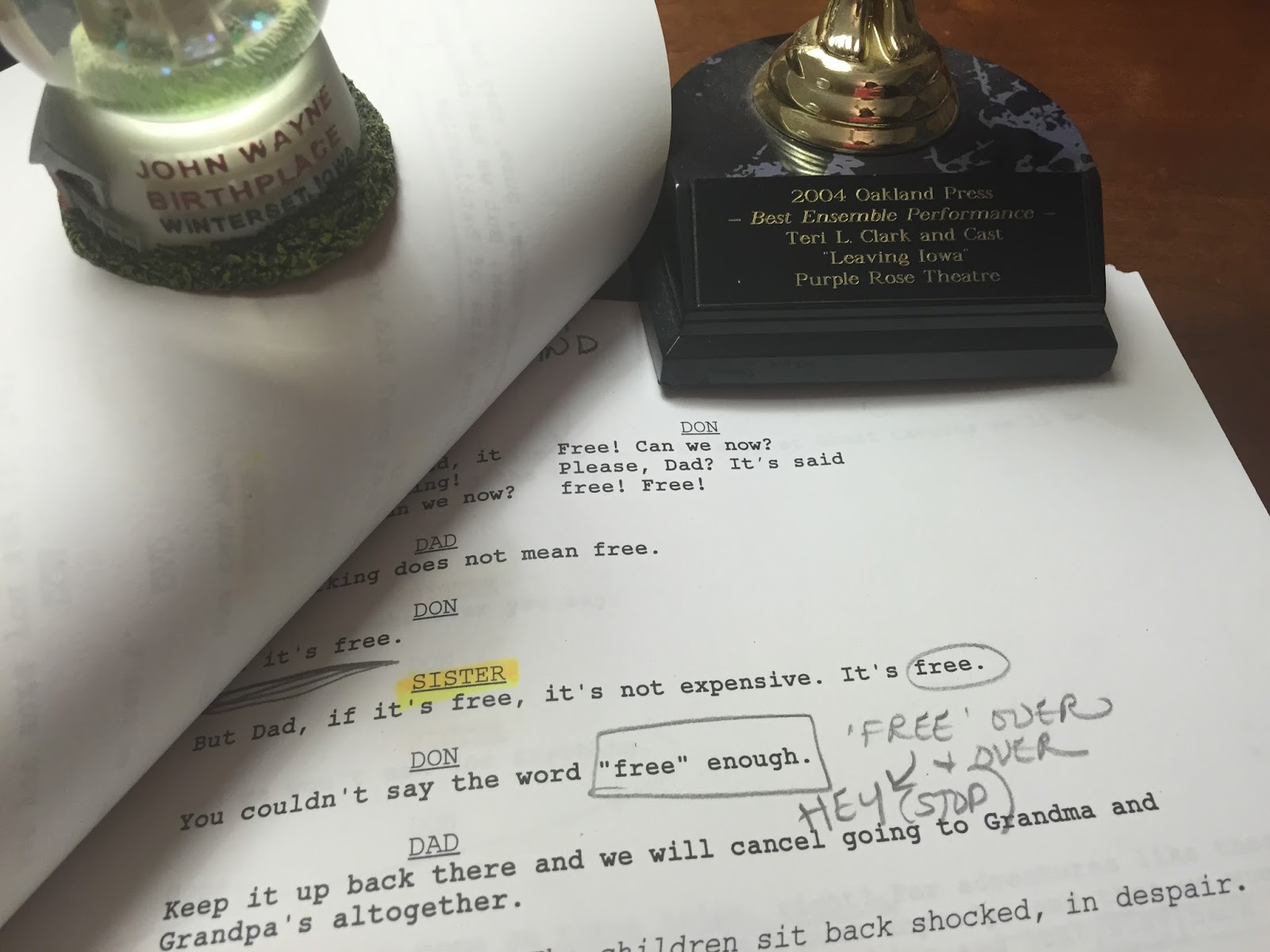
Revisiting LEAVING IOWA walking the dog with my son began with me recounting to him the scene where Sis and Don, on vacation with their Dad and Mom, drive through Iowa on what was to be their last family summer vacation together.  They spot the tourist stop Ghost Caverns and beg Dad relentlessly to go.  After nearly two pages of, "Please, Dad's," and "Why not's?" Dad says it's too expensive and Sis and Don's argument is shut down.  Then they spot a free parking sign and start back up again, chanting at one point, "Free, free, free, free, free," to which inevitably, Dad, exhausted (all while driving and being pestered from the backseat) says the two words described by adult Don in the play as, "The words of a broken man,": "We'll see."  (Of course in kids speak, 'We'll see' means YES.)  Sam enjoyed my telling so much, he began chiming out a chorus of 'Free's' and asking me to tell it again, even becoming 'Dad' to my 'Sis', which led to my dusting off the 11 year-old binder-clipped script and reading it aloud to him (and speaking all the parts) before bedtime.

It was great to say the least to give my voice to all the characters in front of Sam, as it was enjoying remembering how I said most of my Sis lines.  I kept thinking though I'm over a decade older since playing Sis, I could still embody that young person's energy and voice.  I could also play Mom now.  Funny enough, Sam pointed out how similar I am to Dad, who has an immense love of family togetherness and American history, especially when I read the scene where Don and Dad visit a Civil War re enactor ("Fascinating!") and Dad becomes part of the re-enactment (Dad's enthusiasm mortifies Don) this on the heels of re-watching episodes from Ken Burns Civil War documentary this past week.

Also great is still having friendships with the people I enjoyed LEAVING IOWA with so long ago.  "Aw, man, we were just talking about that play!" replied Tony Caselli, when I emailed him about my telling the story to Sam last night.  I remember when we performed LEAVING IOWA at the Rose and it was sold out every performance the six weeks it ran.  The ushers had to sit on the stairs.  The audience collectively laughed and cried every show.  The reviews were stellar.  Jeff Daniels (Executive Director at the Purple Rose Theatre) said if he'd known what kind of success LEAVING IOWA was going to have he would have put it in the summer slot for that season (longer run.)

I have so many great memories from doing Leaving Iowa at the Purple Rose and Williamston Theatres, too many to share here tonight.  I imagine myself an old lady one day, surrounded by just a few precious mementos to occasionally take out and look at for a smile.  One will be a little snow globe that reads JOHN WAYNE BIRTHPLACE, WINTERSET, IOWA, setting for LEAVING IOWA (which references John Wayne's birthplace in the script.)  I gave one of these to cast and crew on opening night at the Purple Rose. The other, a plastic statuette from the Oakland Press for BEST ENSEMBLE PERFORMANCE in LEAVING IOWA (the only non-certificate award for performance I've ever received.)  Maybe too, my first loose leaf script, and the published paperback version, which has my name among the rest of the cast from the 2004 Purple Rose Production (only 1 of 2 published plays my name, as being a part of an original cast, appears in.)

Cover of published paperback LEAVING IOWA script, by Tim Clue and Spike Manton.
Inside published script, Acknowledgments with my name (then Teri Clark) along with the rest of the Purple Rose Theatre cast and directors.
Original LEAVING IOWA script with opening night gift and acting award.
LEAVING IOWA original cast from the 2004 Purple Rose Theatre production, directed by Tony Caselli, Artistic Direction by Guy Sanville, from bottom right clockwise: 
Elizabeth Townsend (Mom) Grant Krause (Dad) Me & John Lepard (Don)
photo courtesy Purple Rose Theatre, c. 2004


Tuesday, June 23, 2015

Culligan Man Concert

You never know what creativity lurks in the hearts and minds of the every day people you encounter. Enter Roy Lovely.  Culligan water softening company technician for 40 years who came to my house this afternoon for an annual maintenance check on my water softener and right before leaving and seeing my guitar asked, "Do you play guitar?"  That sparked a conversation about my still wanting to learn how to play and Roy's playing, composing and recording since he was 12 (I'm guessing somewhere around 5 decades now) and me showing him my mom's Fender.

Roy tuned it and then knelt down (he declined the chair I offered him) and began playing a concert of what can only be described as a guitar symphony of sounds.  His first number reminded me of my mother playing the song Freight Train when I was a little girl, something I hadn't thought about in a long time.  When Roy was finished he told me he composed that song and began playing another.

Then there was more conversation about his daughter's beautiful singing voice and her accomplishments singing at Carnegie Hall and singing the National Anthem at the Cincinnati Red's stadium, as well as Roy's love of making CD's of his original music incorporating all the different tracks of instruments he's laid down himself ("Except for drums," - he uses the software's drums.)  He also talked about all his time in the USAF and playing in a band while touring, and in England (the band in England recorded and album and almost appeared on television) and when he returned from the Air Force, playing again with his high school band VFW's and bars all over the Fairborn and Dayton area (which he gave up 20 years ago...but, as Roy said, will never give up playing and recording.)

Remembering hearing today how feature film composer James Horner had died, I told Roy I'd come across many short and independent film makers who could use someone like him composing for their films. He said he always told his wife all it would take would be one song to be used on one feature film to set them for life!

I walked Roy out to his company Culligan van and he played some of his CD for me with tracks he'd composed (including the first one he played on my Fender.)  I closed my eyes and tapped my foot, basking in the warm sun and smiling outward and inwardly at this little gift I'd been given.  Roy's music evoked emotional memory and pleasant feelings from when I was a child and being with my mother during summer, and all the times she'd play guitar and sing.

I told Roy about my local WYSO radio station connection that broadcasts NPR in the Dayton area and whose station manager and national announcer are my backyard neighbors, and suggested his story and music be great on one of their local spotlight stories.  Roy is going to drop a CD off (he doesn't mass produce and sell these.)  I'm not sure yet of my part (if any) with having Roy's music and knowing the folks I do at the radio station, but if I do it'll be to get his music into the hands of the ones who can get it heard by many.  Maybe my encounter with Mr. Roy Lovely and his sharing his gift of music this afternoon was just a reminder about being open to receive, because you never know when and where gifts will show up, and you should always be ready.

The music connection.  The artist connection.  The creative connection.  The heart connection.


Mom's Fender, freshly tuned and played (even after Roy left, a little bit by me.)


Wednesday, April 15, 2015

Author Sarah Price Interviewed Me!

Couldn't be prouder to have been interviewed by Author Sarah Price for her blog.  I narrated (& thoroughly enjoyed) her book AN EMPTY CUP for Brilliance Audio, which was released on Audible this week.  Check out the blog and see how my dog (also a Tiger's fan) upstages me!

Sarah Price Interviews Me!

Wednesday, August 13, 2014

FREE VOICEOVER LESSONS: BASICS/TECHNIQUE PT. 2, TRICKS

I discontinued voice-over training and coaching, and for years still received inquiries about how to start a voice-over career (which simply has no concise response.)  While no longer teaching, I have decided to post increments from my Basics Training Event Workbook here, with a link to an audio track narrated by me.  It's my hope to help those interested in learning more about voice-over and what's involved in starting a career.

The 10th in the series of voice-over basics is from the section TERI'S THREE T'S: TRAINING, TECHNIQUES AND TRICKS.

 TCVO Presents…

SPRING INTO VOICE-OVER!

© Teri Clark Linden, 2014


Breath

Being aware of your breath and how it changes and affects your body through emotion will help you in your voice-over performance, as will being able to calm and control your breath, getting rid of the anxiety and fears that can come with an audition or performance in front of clients.

Voice Placement

Where you place your voice is key to what sound is produced and especially when creating characters.  In “Talking Funny for Money” page 23, Pamela Lewis defines five basic spots to place your voice before speaking and they are:

Head Voice 
Nasal Voice 
Adenoidal Voice 
Throat Voice
Chest Voice


I encourage getting a copy of her book with recordings and going through the simple exercises.

Volume


I sort of touched on volume talking about microphone placement. Volume at the microphone can be manipulated by a good sound engineer. Practice a whisper into the microphone and play it back. You’ll be surprised at how loud it sounds. Most people are. Volume is a key element to creating a character voice next to placement, attitude and accent. Or are you talking to your neighbor over your backyard fence while flipping tofu burgers (and remember, no yelling directly into the microphone!) Or, are you speaking to your mate side by side at a classical ballet and don’t want to disturb the performance? 

Text 

Text manipulation in commercial voice-over is a trick or style to self-direct a unique and good performance out of you. I’m not talking about changing words or adding words to what a copywriter or creative director has written (though, there are times in sessions or auditions, when after several takes – or for the last audition take – I may take liberty with one or two words to elicit a different feel or set a scene).
© Teri Clark Linden, 2014


I've been doing a lot of cycling this summer & here's a #selfie from one of my rides!  Follow me @tclarkvomamma on Instagram for more!  xo


Thursday, July 10, 2014

FREE VOICEOVER LESSONS: BASICS/TECHNIQUE PT. 1, MICROPHONE PLACEMENT

I discontinued voice-over training and coaching, and for years still received inquiries about how to start a voice-over career (which simply has no concise response.)  While no longer teaching, I have decided to post increments from my Basics Training Event Workbook here, with a link to an audio track narrated by me.  It's my hope to help those interested in learning more about voice-over and what's involved in starting a career.

The 9th in the series of voice-over basics is on the Microphone Placement.

 TCVO Presents…

SPRING INTO VOICE-OVER!

© Teri Clark Linden, 2014


Microphone Placement

As with the voice, where you place your mouth in relationship to the microphone also effects your sound. The best way to discover this for yourself is practice. Get a microphone, download free Audacity recording software on the Internet and play around with how close or how far you are from the mic, whispering or shouting, talking at the mic directly or from a side angle, walking up to the microphone speaking, etc. Here are a few basic tips:

Distance


Basic, traditional distance from your mouth to the microphone is five fingers (standing directly in front of the microphone place your hand with your pinky finger touching the mic (or pop filter) and your thumb touching your lips. Close-up distance from your mouth to the microphone is three fingers. Same methodology as above – remove pinky and thumb.

Setting Levels
A good engineer will set your microphone with you in front of it. Then, she will move to the engineer booth where she will set volume levels with you reading the copy in front of you. Keep reading the copy, even if over and over, until the engineer tells you to stop. Your levels are set, you are planted. If you do walk-ups to the microphone for effect, remember where your first mark was (I use a pen or pencil at my feet before moving). For narration or audio book jobs, I have been asked to set different volume levels based on scenes where I may be shouting or getting very quiet. This is something for you and your engineer to discuss.

Effects


Yelling

Never yell into the mic. You will sound horrible and distorted and cause damage to your sound engineer’s poor eardrums (not to mention the fact you may never be asked back!). There are a couple of ways you can get a “yell” effect at the microphone. One way is to step a good foot directly back from the mic. If you do this, remember where your engineer placed you initially when setting levels and try to walk back into that spot. The other way is by turning your head away from the mic (staying planted) to the left or right at approximately 10 or 2 o’clock.


Whispering. Pat Fraley suggests not whispering into the mic as it doesn’t sound that great, but instead lowering your voice to what is called “Sotto Voce” at the close-up distance at the mic (or even closer – I feel I’ve swallowed the mic at times) creating a very soft effect. Think about volume used talking to a sleeping baby or an aside to someone when you don’t want the others in the room to hear.

Groups

Not very common, but it does occasionally happen (like at the agent’s office when auditioning in a group read for a voice-over) where you find yourself with 1, 2 or even 3 other people around a microphone, and most likely with script in hand. If one- page (and okay with the person who gave you the script) fold up your script into the tiniest one page possible, retaining all of the lines you need of course (this usually means getting rid of extra white space, Halo Data or video description in the case of TV commercial voice-over copy). 
© Teri Clark Linden, 2014

Tuesday, March 25, 2014

FREE VOICE-OVER LESSONS: BASICS/NAME SLATE & PERSONAL STYLE

I discontinued voice-over training and coaching, and for years still received inquiries about how to start a voice-over career (which simply has no concise response.)  While no longer teaching, I have decided to post increments from my Basics Training Event Workbook here, with a link to an audio track narrated by me.  It's my hope to help those interested in learning more about voice-over and what's involved in starting a career.

The 8th in the series of voice-over basics is on the Name Slate & Personal Style.

 TCVO Presents…

SPRING INTO VOICE-OVER!

© Teri Clark Linden, 2014

Name Slate
I’m going to jump in here with one of the basic things you’ll need to know about before auditioning for voice-over jobs and that is the name slate.  In voice-over, your name is usually the first thing the casting person listening to your audition will hear.  Sometimes, your name is all they hear before moving onto the next audition, so it’s extremely important how you sound while saying it.  

Ways to Slate & Personal Style
There are many ways voice-over talent slate.  Sometimes a slate is determined by personal choice and sometimes by the genre of job being auditioned for.  Personally, when slating for straight-forward commercials and narrations (no character roles) I simply say, “This is Teri Clark Linden.”  If the script is light and humorous, I’ll bump up my energy and say, “Hi!”  or “Hello” in front of that.  I will always slate in the vocal style the direction calls for in the script (speaking to commercials).  If they want a textured, smoky or husky sounding voice, that’s the voice I slate with.  If it’s upbeat, friendly Mom, the slate gets that energy and voice, and so on.  

With cartoons I slate in character, be it for animation or commercial.  For demos, I have heard several where a male voice slates on a woman’s voice-over and woman slates on a man’s (I have done this for a couple of students whose demos I helped produce).  I have also heard what’s called “end slates,” where the name slate comes at the end of the demo, usually saying something like, “Thanks for listening to Teri Clark Linden.”  I haven’t heard end slates nearly as much as front end ones though and they are usually found on character-voice demos.  I think the demos that really jump out when I listen all have a unique way they are produced.  Frequently, I listen to top-tier agency demos on the website www.Voicebank.net (where my demos can be heard as well) centering in on those in the larger markets like LA or New York.  At my New York agency there is a talent named Mindy Bell whose commercial demo is quite funny.  Right away I get the sense that Mindy Bell’s personal style is comedy.  I would say my personal style is texture.  I can jump in and out from using a textured, throaty sound (think Demi Moore) to a clearer one.  I think I also have a warm quality with commercials and a good sense of comedy as well.  The more training and practice you have the better you’ll be able to identify your personal style and what scripts you best perform to include on a demo.
© Teri Clark Linden, 2014


Thursday, March 13, 2014

FREE VOICE-OVER LESSONS: BASICS/CONVERSATIONAL READ

I discontinued voice-over training and coaching, and for years still received inquiries about how to start a voice-over career (which simply has no concise response.)  While no longer teaching, I have decided to post increments from my Basics Training Event Workbook here, with a link to an audio track narrated by me.  It's my hope to help those interested in learning more about voice-over and what's involved in starting a career.

The seventh in the series of voice-over basics is on the Conversational Read addressing Traditional vs. Modern Announcer.
 TCVO Presents…

SPRING INTO VOICE-OVER!

© Teri Clark Linden, 2014


CONVERSATIONAL READ


Traditional vs. Modern Announcer
In my two decades of recording commercial voice-over scripts (“copy”) nearly all copy with Announcer roles give the direction to be “real” or “conversational,” and sometimes “non-Announcery.”  What the people want who write or give this direction is to hear a voice talking as if you were just having a normal conversation with one other person.  They don’t want someone selling or pushing their product onto them.

Pamela Lewis has a really great way of introducing this idea to basic voice-over talent with a simple script for what she calls the “Traditional” vs. “Modern Announcer.”

Now, the Traditional Announcer is not by any means pushing or selling his product either, or have a voice in the old fashioned game show Don Pardo style (think The Price is Right and “Teri Clark Linden…come on down!”).

Traditional Announcer
Here is the direction Pamela gives for the Traditional Announcer’s two lines:

Line 1: Statement of love.

I love this product. 

(Think, “I love my __________________,” and you fill in the blank – grandma, mate, kid, dog, corvette, whatever.  Be specific and mean it.)

Line 2: Come join me in the love.

I know you will too.

(Think, while smiling warmly and sincerely, “Come join me in the love,” and really want the other person you are talking to – and pick one person and really pick them, don’t fake it – to love your grandma, mate, kid, dog, corvette or whatever too!)
For the Modern Announcer, it’s the same commitment emotionally, but just more laid back, and you guessed it, “conversational.”  The Modern Announcer is just a regular person like you and likes what he is talking about too.  Again, pick a person you are talking to and put yourself into a scenario – like sitting across your kitchen table after breakfast over coffee, or in the backyard over the fence to your neighbor, or whatever.  The more specific you are the more the listener on the other end of the television or radio listening the commercial will connect with what you are saying and ultimately (because that’s what commercials are for) selling.  
Modern Announcer
Here is Pamela’s direction for the Modern Announcer:

Line 1.  

It’s a great product.  

(Think, “Yeah, sure…my grandma is pretty great.”)

Line 2.  

Why not check it out?  

(Think, “Sure, meet her or not, either way is okay & I’ll still like you anyway.”)

The difference here is Modern Announcer is not emotionally committed one way or another.  I’m not saying be apathetic and feel nothing.  But unlike Traditional Announcer where you really do connect emotionally with the product (or “Grandma”) you are talking about and want the listener (your one person) to join you in the emotional connection, Modern Announcer is more laid back and rather than expressing deep feelings for what he or she is talking about, is merely relaying the information – having a conversation.

Don’t worry if this doesn’t make sense or resonate with you right away.  Performing a “conversational” read in commercial voice-over is one of the most difficult things to do for a lot of very experienced and very talented people, especially those with a strong background in radio imaging and disc jockeying.  

TRADITIONAL VS. MODERN ANNOUNCER PRACTICE SCRIPTS

TRADITIONAL ANNOUNCER

I love this product.  

I know you will too.

MODERN ANNOUNCER
It’s a great product.  
Why not check it out?


My Son listening to one of my recent audio book narration files for the day (Aunt Dimity & the Wishing Well, by Nancy Atherton.)

© Teri Clark Linden, 2014

Monday, February 10, 2014

FREE VOICE-OVER LESSONS: BASICS/PROFESSIONAL PROTOCOL PT.3

I discontinued voice-over training and coaching, and for years still received inquiries about how to start a voice-over career (which simply has no concise response.)  While no longer teaching, I have decided to post increments from my Basics Training Event Workbook here, with a link to an audio track narrated by me.  It's my hope to help those interested in learning more about voice-over and what's involved in starting a career.

The sixth in the series of voice-over basics is the 3rd of 3 posts on Professional Protocol, addressing Session Etiquette and Professional Apology. 

TCVO Presents…

SPRING INTO VOICE-OVER!

© Teri Clark Linden, 2014


PROFESSIONAL PROTOCOL


Attitude (See previous blog "Basics/Professional Protocol Pt. 1)

Teri’s Golden Rules (See previous blog "Basics/Professional Protocol Pt. 2)
Session Etiquette
Professional Apology


Session/Audition Etiquette
It’s a party: You’re invited!
Arrive on time
Ask questions
Everyone is right
Read the situation

Professional Apology

Pamela Lewis (author of Talking Funny For Money) introduced me to the idea of “Professional Apology,” and I want to pass it on to you.

Confidence is key to coming across at the microphone successfully.  No one likes to feel intimidated or insecure and certainly when we make mistakes feel bad for it.  We are human.  We make mistakes.  Or, we make choices we think are brilliant only to get the feedback that they weren’t, and could we please do something else?  Whatever the case, don’t take it personally and crumble.  Pamela suggests using the following sentence with the intention of Professional Apology:

Professional Apology Practice Script


“I’m sorry.  Let me try that again for you.”


Practice breaking this into two different thoughts, with the first thought being, “Oh, I’m so sorry!  I’ve had eight bookings already this morning and I’m fried!”  The second thought is a completely sincere, while smiling, “Let me try that again for you.”  Now with the first thought, you don’t want to come across arrogant by any means.  It’s just one of those mornings, where you have been so busy ‘where is your head?’ and ‘let’s get it back on now!’  Don’t crumble or come across as insecure and weak either.  Smiling while you say anything at the microphone always makes what you are saying come across with a smile too.  Practicing professional apology will keep you out of a self deprecating place and into a professional one.
© Teri Clark Linden, 2014


Wednesday, February 5, 2014

Film Role

Little diversion from my Voice-Over reporting to write about an upcoming on-camera project I just found out about 3 days ago:

So lucky to be last minute replacement for lead in small indie film produced and directed by Ohio U upperclassmen for their "419 production" class. Embarking on a journey researching an actual leading role (v. the 1-5 line one scene Studio films I usually do) and researching & Skyping & collaborating on everything from script table work to wardrobe.  It's like a Master Class where I get paid for my attendance and work!  I get to Skype with the lad playing my son tomorrow (in our "Thelma & Louise"-like Mother/Son story) and start shooting this weekend.  Oh, and I can add Texas to my list of states I've visited. I'm being flown there for a few days in March to shoot some road trip scenes (where I'll be at the helm of a '63 Ford Falcloln - oh, yeah, it's a period piece...1965.) Living my dream.  Stay tuned.
Fringe I cut tonight for the role.

Monday, February 3, 2014

FREE VOICE-OVER LESSONS: BASICS/PROFESSIONAL PROTOCOL PT. 2

I discontinued voice-over training and coaching, and for years still received inquiries about how to start a voice-over career (which simply has no concise response.)  While no longer teaching, I have decided to post increments from my Basics Training Event Workbook here, with a link to an audio track narrated by me.  It's my hope to help those interested in learning more about voice-over and what's involved in starting a career.

The fifth in the series of voice-over basics is the 2nd of 3rd posts on Professional Protocol, addressing "Teri's Golden Rules." 

TCVO Presents…

SPRING INTO VOICE-OVER!

© Teri Clark Linden, 2014


PROFESSIONAL PROTOCOL


Attitude (See previous blog "Basics/Professional Protocol Pt. 1)

Teri’s Golden Rules

Session Etiquette
Professional Apology


Teri’s Golden Rules
An actor never directs another actor
Don’t take anything personally
Check your ego at the door
Fire your judge

I have come up with a few golden rules I try to live by when auditioning and working around others.  Number one, especially in the acting world is AN ACTOR NEVER DIRECTS ANOTHER ACTOR.  This pertains at the microphone as well.  It’s up to the director to communicate to the actor what is wanted and if you are a good enough actor, you will be able to get what you need from another actor with what you give them, not with what you tell them.  It’s taboo. 

Rule number two for auditions and sessions: DON’T TAKE ANYTHING PERSONALLY.  You can apply this to life as well.  (There is a great book written by Don Miguel Ruiz called The Four Agreements and not taking anything personally is one of the agreements.)  Your director’s mood is your interpretation made by your ego and that’s all.  It’s a wonderful thing when personalities mesh and everyone gets along, but sometimes that’s not the case.  Don’t focus on negative perceptions, but keep your energy on the task at hand, keeping your mood light and pleasant at all times.  Set the tone.  

Here’s rule number three: CHECK YOUR EGO AT THE DOOR.  No one likes to be around a big head.  You’re all there to accomplish the same thing: a good audition or a good commercial spot.  


This leads to number four: FIRE YOUR JUDGE.  You are your own worst critic.  You and your ego will get in the way of your creativity and professionalism every single time and ruin a good session or take.  Be open to your director and fellow actors.  Give to them and they will receive what you give, be inspired and give back.  When they don’t, reach into your bag of tricks you learned from your training because that’s what it’s there for.  

Monday, January 27, 2014

FREE VOICE-OVER LESSONS: BASICS/PROFESSIONAL PROTOCOL PT. 1

I discontinued voice-over training and coaching, and for years still received inquiries about how to start a voice-over career (which simply has no concise response.)  While no longer teaching, I have decided to post increments from my Basics Training Event Workbook here, with a link to an audio track narrated by me.  It's my hope to help those interested in learning more about voice-over and what's involved in starting a career.

The fourth in the series of voice-over basics is an introduction to Professional Protocol, which I have broken down into four points and will addressed over the next 3 blogs.
TCVO Presents…

SPRING INTO VOICE-OVER!

© Teri Clark Linden, 2014


PROFESSIONAL PROTOCOL

Attitude
Teri’s Golden Rules
Session Etiquette
Professional Apology

Attitude

In my opinion, there are two ways to define a professional performer: whether or not they belong to a professional performer’s union or by their attitude.  You can be a professional actor, member of the acting unions and still display amateurish behavior behind the microphone and to those around you.  On the reverse, you might not yet have your union cards but act completely professionally, treating those around you with respect and courtesy.

You can also choose to have a positive attitude regarding auditions and bookings, by not getting discouraged with jobs you don’t get and appreciating (rather than feeling it’s deserved) the ones you do.  Treat every voice-over audition or job you get as an invitation to a party.  Be thankful for the opportunity.  When around others, keep in mind they all desire the same end result, and that is to get the job done well, whether recording an audition or project.  Your positive attitude goes a long way in this business and will get you known and remembered as someone easy to work with.  No one likes an egomaniac.  No one likes being around negative people, or being criticized, especially in front of others.  
© Teri Clark Linden, 2014